Saturday, January 1, 2022

Northumbrian English Civil War

The Saxon Kingdom of Northumbria covered much of the North of England, coast to coast from the Humber to the Tweed.  Viking colonisation saw the Kingdom broken up and during Norman times it developed into the county structure as the basis for local government. Northumbria became synonymous as the counties of Northumberland and Durham.


Northumbria played an important role in the First English Civil War. Firstly in the events, the Bishops Wars, that contributed to the outbreak of the conflict, then as a key strategic region during the fighting which ended in Northumbria with the Siege of Newcastle in 1644.

Siege of Newcastle 1644

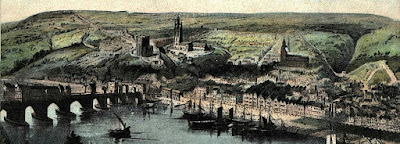
The legacy of the English Civil war can still be seen in the crest of Newcastle. The motto added to the fourteenth century crest , Fortiter Defendit Triumphans (Triumphing by Brave Defence) was adopted during the Civil War, following the stubborn defence of the town against the Scots in the siege of 1644.


NEXT: Charles I ascends to the throne


Wednesday, March 27, 2019

Charles I ascends to the throne

 On the 27th March 1625 Charles I ascended to the thrones of England and Scotland on the death of his father King James I & VI.

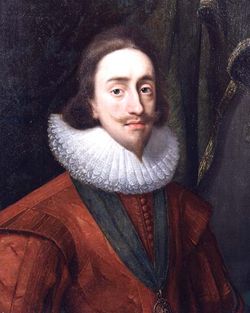
King Charles I

James VI of Scotland had succeeded to the Scottish throne  in 1567. He was the only son of Mary Queen of Scots and Henry Stuart, Lord Darnley, both of whom were great-grandchildren of Henry VII of England through his oldest sister Margaret Tudor. When Elizebeth I died childless on 24th March 1603, it was this lineage that saw the English throne pass to James. Thus he became  James I of England and James VI of Scotland and the monarchical lineage passed from the House of Tudor to the House of Stuart. 


House of Stuart Royal Arms

Charles therefore inherited the thrones of two separate nations each with their own parliaments, judiciaries, and law.  

Charles realm included Ireland. James I and VI had officially sanction the Planation of Ireland in  1609. This was an organised colonisation of a mainly catholic Ireland with settlers who in the main were protestant  immigrants from Scotland and northern England. This colonisation, together with wealthy English landlords taking over lands, meant simmering tensions existed in Ireland.


Charles like his father believed in the divine right of  Kings, that the monarch was accountable to god and not an earthly authority such as Parliament. He saw Parliament merely as a conduit to pass laws to enact his policies, as well as a means to raise taxes to meet the King's expenditure, in particular the costs of the military engaged on campaigns decided by the King.

Parliament could only be convened on by order of the King and he could dissolve it when ever he wished. 


King Charles I believed in the divine right of Kings


When Charles came to the throne, continental Europe was at war. War began in 1618, when Ferdinand II was deposed as King of Bohemia and replaced by Frederick V of the Palatinate (Rhineland), who was married to Charles's sister Elizebeth. The conflict escalated to become a struggle between the Lutheran and Catholic states of the Holy Roman Empire and a power struggle for dominance between the Habsburgs of Spain and Austria, and the French House of Bourbon.


Conflict in Europe within the Holy Roman Empire

In 1624, the anti-Catholic sentiment of Parliament, as well as Charles's(then Prince of Wales) desire to support his sister in Lutheran Rhineland led to the authorising of funds for war. A mercenary army under the command Count Mansfield for service in the Palatine was raised, and the strengthening of the English navy.

Shortly after becoming King, Charles married by proxy Princess Henrietta Maria of the French Bourbon family. The princess was a Roman Catholic and the marriage was opposed by many  Parliamentarians fearful that Charles might make concessions to  Catholics and undermine the Church of England. 


Princess Henrietta Maria


Charles was crowned King of England  at his coronation at Westminster Abbey  2nd February 1626.

Coronation King Charles I
Westminster Abbey


It would be 7 years before Charles would hold is coronation in Scotland. He travelled north staying at Raby, Aukland and Durham castles en route. He visited Newcastle on 3rd June and Tynemouth on 5th June 1633. He was crowned at St Giles Cathedral in Edinburgh on 18th June. 


Coronation King Charles I
Edinburgh


Charles I Government

 The origins of Parliament and the challenge to monarchical power began in June 1215 King John signed the Magna Carta to make peace with rebel barons who were displeased with the way John was ruling the country. Magna Carta established the principle that the King was subject to laws in the same way his subjects. 

During the reign of John's son Henry III (1216 to 1272), the rule of the country by an absolute monarch was ended. Following a power struggle between Henry and his barons, the noblemen won and the rebel baron's leader, Simon de Montford called the first Parliament in English history which had no prior royal authorisation.  Montford's parliament was a single chamber consisting of bishops, noblemen together with two knights from each shire and two burgesses from each borough.

From 1295 Parliament met at the palace of Westminster.

In 1341 the clergy and nobility met separately  from the knights and  burgesses which created an Upper Chamber (House of Lords) and a Lower Chamber (House of Commons), with the knights and burgesses sitting in the latter. The structure of the Lower Chamber would develop into the representatives being Members of Parliament representing constituencies. The monarch ceased to be a member of either chamber by the time Henry VII came to the throne in 1457, relying now on supporters in both chambers to influence the affairs of Parliament. 

In 1534 Henry VIII broke away from the authority of the Catholic Church in Rome and established himself as the head of the Church of England. The Church would no longer answer to the authority of the Pope in Rome, but to the King.  The Archbishop of Canterbury, the first and most senior Bishop of England was appointed by the King, thus consolidating the monarchs power within the church. 

During the Tudor period (1485 to 1603) the relationship developed between the Monarch and Parliament. The monarch could convene and dissolve Parliament whenever they wished. They did however look to the support of Parliament as a means to legitimise decisions and raise money through taxation.

Westminster the power base of Parliament

The day to day running of the country lay with the Privy Council. This consisted of advisers to the sovereign and the means by which the monarch exercised their power through their royal prerogative. The council could be a a place of intrigue and positioning for favour of the King, a power struggle within the court, and also another source of conflict with Parliament. 

Court of Charles I

On ascending to the throne Charles I retained James I & VI's principal adviser, the Duke of Buckingham, as his primary confidant. Buckingham 

Buckingham had accompanied Charles, when he was heir to the throne, to Madrid in in 1623 in an ill-fated attempt to arrange a marriage Infanta Maria, sister of Philip IV of Spain. It was Buckingham who negotiated Charles' marriage to the Catholic princess Henrietta Maria of France. This action together with his his monopoly of royal favour and patronage made him extremely unpopular with parliamentarians. 

George Villers
Duke of Buckingham


A member of either chamber could propose a Bill for deliberation by Parliament. As members of the Privy Council sat in Parliament, the monarchs proposals could be put to both chambers for consideration. In order for a Bill to be passed into law it had to be approved by a majority in both Houses of Parliament. The monarch would need to give royal ascent before it became an Act of law, giving them the power of veto, another area of contention between the monarchical and parliamentary power.

The House of Commons consisted of Members of Parliament 'elected' from County and Borough franchises. Each franchise returned two members. In addition the Cinque Ports each returned two members, as did the University franchises of Oxford and Cambridge. [1]  An exception was the County Palatine of Durham which was administred by a "Prince Bishop" who's powers dated back to medieval times. Durham did not return any MP's to Parliament. [2] 

Stuart England


In County franchises those allowed to vote was restricted to resident freeholders who's with a freehold value of land or property was 40 shillings a year. [3] 

The voting qualification in Borough franchises  varied. It could be based upon payments to local poor and church rates, or the ownership of a hearth on which to cook a pot. It may be based upon the payment of  monies to the king or local lord. [4] Some cities required those who voted to be freemen of that city. Some boroughs would only allow those who were members of the corporation that ran the town, often men under the patronage of local dignitaries. [5]


--------
[1] The History of the Parliamentary Franchise RESEARCH PAPER 13/14 1 March 2013 page 5
[2] ibid page 8
[3] ibid page 8
[4] ibid page 10
[5] ibid page 11

Charles I Northumbria

North of England

The lands  from coast to coast north of the River Humber and south of the River Forth had formed the Kingdom of Northumbria in Saxon Britain. 

Kingdom of Northumbria around 700AD

The Viking colonisation of the north led to a break up of the Kingdom, with those lands north of the River Tweed being absorbed into what would become Scotland. The lands between the River Tees being divided between the Earl of Northumberland and the Bishop of Durham. [1]

9th Century England


Immediately after the Norman conquest the lands north of the River Tees were not formally incorporated into the Kingdom of England. They continued to be controlled by the Bishop of Durham and the Earl of Northumberland. It was not until 1095, that those lands were  incorporated into England, Northumberland becoming a county and subject to crown rule, Durham becoming a Palatinate under the control of the Bishop of Durham. [2] 

Palatinate of Durham

The Palatinate of Durham lay principally between the River Tess and the River Tyne. The Bishop controlled local government and the judiciary and appointed officials. The Bishopric was however subject to the laws of England and although the Palatinate issued it's own coins, they had to be of the same denomiation and value as the coinage of England. It was the monarch's prerogative to choose who was the Bishop of Durham, and whilst he could not dismiss the bishop, the monarch could limit the clerics power and the lands that formed the bishopric. Durham did not have any Parliamentary Constituencies, so  there was no representation in the House of Commons. [3] The Bishop of Durham sat in the House of Lords.

County of Northumberland

The accession of James VI of Scotland to the English crown brought a formal end to hostilities with Scotland, and Northumberland could enjoy a period of peace and stability. The county of Northumberland was mainly agricultural with the exception of the growing coal industry around Newcastle. By the time Charles ascended to the throne, over 400,000 tons of coal was being shipped from Newcastle, the primary market being London, as well as exports to the Low Countries and the Baltic. The control of the shipments resting mainly with a small cartel of Newcastle merchants. [4]

There were four Parliamentary Constituencies, each having two Members of Parliament sitting in the House of Commons in the county Northumberland; Northumberland, Newcastle, Morpeth and Berwick upon Tweed.

The constituency of Northumberland was dominated by local gentry with elections being held at the official county town of Alnwick. The two MP's elected to sit in Charles I first Parliament were landowners, Sir John Fenwick and Sir Francis Brandling. [5] 

17th Century Alnwick

Newcastle was governed as a corporation which selected the constituencies' Members of Parliament. The corporation consisted of the mayor, sheriff, ten alderman and a common council of 24 members elected by twelve of the towns guilds. The MP's elected to the 1625 were both merchants, Sir Thomas Riddell and Sir Henry Anderson. [6]

17th Century Newcastle

Morpeth was a Borough which was presided over by two bailiffs and seven alderman representing the towns seven trading guilds. Representing the constituency in the 1625 Parliament were Thomas Reynell, a courtier to Charles I and Arnold Herbert a member of the gentry [8], neither of who had a tangible connection to the borough. [7]

The northern most constituency in England was Berwick, a town that had changed hands between England Scotland nine times during medieval conflicts, before finally coming under permanent English control in 1482. Those selected to represent the town in Parliament were chosen by the freemen of the borough. Those elected to the 1625 Parliament were Sir Robert Jackson, a merchant, and a member of the gentry. Sir John Selby. [8 ]

17th Century Berwick


Sitting in the House of Lords were the Bishop of Durham and the Earl of Northumberland. [9]

The Bishop of Durham was Richard Neile who had been appointed in 1617. [10] Neile had appointed William Laud, Charles I future Archbishop of Canterbury, as his chaplain when he was Bishop of Rochester. Neile would go on to use his political connections to become part of the Kings Privy Council. 

Richard Neile Bishop of Durham


NEXT: Charles I in conflict with Parliament

------------

] Richard Lomas, An Encyclopaedia of North East England, Edinburgh: West Newington House; 2009 page 333-335 Northumbria

[2] ibid page 348 Palatinate of Durham

[3] ibid page 348 Palatinate of Durham


[9] 'House of Lords Journal Volume 3: 9 August 1625', in Journal of the House of Lords: Volume 3, 1620-1628 (London, 1767-1830), pp. 477-485.

[10] List of the bishops of Durham | CCEd (theclergydatabase.org.uk)


Thursday, December 10, 2015

Charles I in conflict with Parliament

 When Charles I issued the writ to convene Parliament on  2nd April 1625 the foundations of his conflict with Parliament were already in place.  

Religious tensions from his marriage to catholic Princess Henrietta Maria of France had raised concerns in Parliament that Charles would make concessions to English Catholics.

Charles' and the Duke of Buckingham were keen to mount a military and naval operations against Spain. However this would require additional funds which Parliament were reluctant to provide, concerned the previous funds had been wasted on the ill fated exploits of German Count Ernest von Mansfield. 

Charles I Parliament 1625

The Parliamentary session began in Westminster on 17 May 1625, moving to Oxford in August due to plague in London. Parliament's main concern was not providing funds for Charles, but the impeachment of Lord Buckingham. He was accused of monopolising power, mismanaging royal finances, and as Lord Admiral failing to defend English merchant shipping from piracy. 

Ignoring Parliament's calls for Buckingham's impeachment and frustrated at not securing sufficient funding for his activities, Charles dissolved Parliament on 12th August 1525. [1]

Despite the lack of funding, Charles and Buckingham sent 10,000 English troops supported an Anglo-Dutch fleet to attack the Spanish  of Cadiz. The expedition launched  their attack early November 1625,  a venture that ended in failure. 

Attack on Cadiz 

Religious tensions worsened. An English fleet loaned to Louis XIII was used against his protestant opponents, French Calvinist Huguenots, angering Parliamentarians. Buckingham supported the theological concept of Arminianism, often regarded as being catholic in it's outlook, and it was felt that this was influencing Charles and his court.

It was against a background of suspicion of the Kings' religious intentions, and the failure of the Cadiz expedition, that Charles was forced to convene Parliament as he was desperately short of money.

Parliament began on 6th February 1626 and again proceedings would become dominated by the desire to impeach Buckingham who was blamed for the ongoing religious problems and the failure of the Cadiz expedition. Formal charges were laid before the House of Lords in May. Charles convinced that the Commons would only supply him with funding if Buckingham was removed,  decided to save the Duke by dissolving Parliament on 15th June. [2]

Despite the lack of funds, Charles and Buckingham dispatched a second fleet to Spain, which was another failure. Many vessels were unable to sail as they were so poorly equipped, those that did were forced to return to port by violent storms. Charles's woes were exacerbated when news that his uncle the Danish King Christian IV had been defeated in battle by the Catholic League. Despite the desperate financial situation, he looked to help support the Danes. 

Charles did not want to call Parliament to raise the funds necessary for his foreign policy aspirations. He therefore imposed  forced loans on his wealthier subjects and encouraged the church to preach sermons as to the loans legitimacy based upon his concept of the Divine Right to rule. The loans did raise funds, though they were deeply unpopular and some noblemen refused to pay resulting in their imprisonment with out trial. Charles also imposed martial law to govern sailors and soldiers engaged on expeditions as well as to force citizens to billet troops without their consent.

Whilst the raising of funds was intended to be used to support the Danish King, a worsening of Anglo-French relations over the winter of 1626 to 1627 had developed into conflict. French Protestant Huguenots rebelling against the increasing threat to their religious and political freedoms had appealed to England for assistance. Charles and Buckingham used funds to dispatch an expeditionary force to La Rochelle where the Huguenots were besieged. One again, an expedition that ended in failure.

Siege of La Rochelle

Despite the set back, it was decided to mount another expedition to support the Huguenot's. Lacking funds, Charles was forced to summon Parliament, issuing a summons at the end of January 1628. As a gesture of goodwill the King released those imprisoned for refusing to pay the forced loans.  

Parliament went into session on 17th March 1628. They agreed to provide funds to the King in return for him accepting a Petition to Right confirming the rights and liberties regarding taxation, imprisonment without trial, billeting of troops without consent and the use of martial law.

Right Of Petition 1628

The King eventually agreed to the Petition, however, there was still disagreement over the tonnage and poundage levies, duties   paid by merchants on imports and exports, often regarded by monarchs as their right to receive.  These levies were essential to the Kings finances and remained unresolved when the Parliamentary sitting ended in June. 

During the summer of 1628, Charles assembled a fleet under the command of Buckingham for another expedition to support the French Huguenots at La Rochelle. Buckingham would not however mount the operation, he was murdered by a disgruntled Army officer in August 1628. The fleet sailed under a new commander, but achieved little.   

Murder of Duke of Buckingham 

Parliament reconvened in January 1629. The issue of the tonnage and poundage levies continued to be main area of disagreement between the King and the Parliamentarians. The dispute resulted in King Charles ordering Parliament to adjourn, to which the Commons refused. Charles responded by having his main opponent Sir John Elliot arrested together with nine other MP's.

Charles disgruntled over the failure to secure the concessions he wanted for the tonnage and poundage levies and angry at the level of opposition from MP's, dissolved Parliament on 10th March 1629. [3]

Parliament dissolved

He would not convene Parliament again for another 11 years, during the intervening period Charles would govern by the Kings personal rule until 1640.

NEXT: Charles visits the North 1633

------

Sources: History of Parliament Online - Survey Chapters 

[1] The Parliament of 1625 | History of Parliament Online

[2] The Parliament of 1626 | History of Parliament Online

[3] The Parliament of 1628-1629 | History of Parliament Online

Author: Andrew Thrush


Saturday, October 9, 2010

Charles I visits the North 1633

Charles I

  In the summer of 1633, Charles I headed north to Scotland where he would be crowned as King of Scotland. Charles had held his coronation to the English throne in February 1626, and now he returned to the country of his birth for his coronation in Edinburgh. The journey north would include visits to Durham, Newcastle and Berwick. 

The notification of King Charles visit had been issued in January 1632. [1] Local officials were required to report on the condition of bridges and highways on the route of the King's journey to Scotland. The justices of Northumberland and Durham reporting in March that they were satisfied that all would be well  by the time Charles arrived. Parish councils made ready for the King, Gateshead expending around £100 (c£12,500 2017 value) to repair roads and infrastructure. [2]

As he made his way to Northumbria,  Charles stayed at Welbeck Hall, Nottingham, the home of William Cavendish, Earl of Newcastle. Cavendish was a wealthy landowner, a friend of the Duke d Buckingham, whom Charles had made Earl of Newcastle in 1628. His mother Catherine Ogle was the daughter of Baron Ogle whose family estates were in Northumberland. When she died in 1629, he inherited the estates making  William Cavendish one of the richest landowners in England. [3]. 

Eager to impress the King Cavendish spent lavishly to entertain the Charles including feasting and  a production by the playwright Ben Jonson, [4] a contemporary of William Shakespeare. 

Welbeck Hall residence of William Cavendish Earl of Newcastle

 Winding his way towards Durham, King Charles and his entourage stayed at Raby Castle. This was the home of Sir Henry Vane, a member of the Privy Council and a close confident of the King. [5] 

Raby Castle home of Privy Councillor Sir Henry Vane

On May 31st, Charles was entertained at Aukland Castle by the Bishop of Durham Thomas Morton. [6] 

Aukland Castle Bishop of Durham residence

In the City of Durham preparations had been made for the regal visit, King Charles entering the via Elvet Head. [7] 

Durham

He stayed at the house of Sir William Selby departing on the morning of 3rd June 1633 bound for Newcastle, [8] arriving the same day. [9].

Newcastle Upon Tyne

 On the 4th, Charles dined with the mayor of Newcastle, William Cole, using the occasion to knight him. The following day the King travelled on a Royal Barge to Tynemouth and visited Shields. [10] Charles would spend another two days in Newcastle receiving petitions, departing on the 7th June. [11]

Newcastle to Berwick route

 The Royal train arrived at Berwick on 12th June {Julian Calendar 2nd June}  where the King would spend ten days [12] During that period Charles examined Berwick's fortifications and ascertained the quantity and quality of the cannon. [13]

Berwick

When King Charles crossed into Scotland he was met by Scottish nobles and gentry as well as a troop of 600 men of the Earl of Home. The monarch spent the night at Dungalss, 20 miles north of Berwick, a home belonging to the Earl. [14]

NEXT

=======

[1] Charles Sandford Terry, The Life and Campaigns of Alexander Leslie First Earl of Leven, Publisher Unknown: 1899 page 83 note 3

[2] ibid page 83 & 84

[3] http://bcw-project.org/biography/william-cavendish-marquis-of-newcastle

[4] http://www.nottshistory.org.uk/white1875/welbeckp1.htm

[5] Sir Henry Vane, the Elder (1589 - 1655) - Genealogy (geni.com)

[6] https://familypedia.fandom.com/wiki/Bishop  (Web view)

[7] A History of the County of Durham: Volume 3, ed. William Page (London, 1928), British History Online http://www.british-history.ac.uk/vch/durham/vol3 [accessed 31 December 2021].

[8] Charles Sandford Terry, The Life and Campaigns of Alexander Leslie First Earl of Leven, Publisher Unknown: 1899 page 84

[9] ibid page 85

[10] ibid page 85

[11] ibid page 95

[12] John Scott, BERWICK-UPON-TWEED The History of the Town and Guild, London: Elliot Stock;1888 page 199

[13] ibid 200

[14] ibid 200


Tuesday, April 13, 2004

Kings Personal Rule

Charles I

Charles I  saw his Personal Rule as exercising the divine right of Kings, to rule by Royal Prerogative, a process that allowed the monarch to exercise executive power without the authority of Parliament. The latter regarding this as going against the principles established in the Magna Carta.

 In July 1628 Charles had appointed Sir Richard Weston (later Lord Portland) as his Lord Treasurer. Weston was an efficient administrator who addressed the financial problems facing the King. [1]  To reduce the largest area of  expenditure, foreign wars, the  Lord Treasurer  persuaded Charles to sign peace treaties with France and Spain. [2] The Treaty of Susa was signed with France 14th April 1629 [3] and the Treaty of Madrid with Spain 15th November 1640. [4]

The peace treaties also brought stability and opportunities for trade and commerce. This resulted in increased monies flowing to the Crown from the poundage and tonnage customs duties, though it was levy that was not authorised by Parliament. [5] Weston increased revenues further by reviving ancient and long forgotten taxes and duties. [6]


Sir Richard Weston (later Lord Portland)
Lord Treasurer

Following the death of the Duke of Buckingham,  Charles formed an inner cabinet of advisers. Richard Weston as Lord Treasurer was appointed [7] just before Buckingham's death.  Sir Francis Cottingham was made Chancellor of the Exchequer in April 1629, and Sir Frances Windeback Secretary of State in June 1632. [9] All three members were catholic sympathisers, creating suspicion of Charles religious intent.

Another key advisor appointed was Sir Thomas Wentworth(later Lord Stafford) who was given the position of Lord Deputy of Ireland in January 1632 [10], the person charged with governing Ireland on behalf of the King.


Sir Thomas Wentworth (later Lord Stafford)
Lord Deputy of Ireland


Charles through his cabinet of close advisers had created the mechanism by which he would discharge his Royal Perogative in affairs of State. He then sort to exercise his control over the Church by appointing a new Archbishop of Canterbury (the primary bishop in the Church of England),  William Laud, in August 1633. [11] 


William Laud
Archbishop of Canterbury


Laud's religious doctrine was based on Arminianism, an anti-Calvinist theology which  was opposite to the views of the Church of Scotland and Puritans. Laud favoured the concept of a state controlled church with a hierarchy of bishops and uniformity across religious denominations. Many people thought his doctrine as pro catholic.

The Thirty Years War within the Holy Roman Empire was still in  progress. The conflict between the French and Dutch with Spain  had seen a build up naval power which was regarded as a possible threat to English maritime interests. In response King Charles directed that the Royal Navy be re-armed with a new fleet to safeguard peace and neutrality. [13] To fund the  initiative it was proposed to levy 'Ship Money'. This was a method of raising monies by requiring coastal towns to pay for the upkeep of naval defences in times of emergency. [14] The use of 'Ship Money' in a time of peace was unprecedented , as was the King imposing the levy without recourse to Parliament.


Writs were issued to the sheriffs of the coastal counties in October 1634 requiring them to collect the monies. [15] A year later in October 1635 further writs were issued, however, this was to all counties, including inland counties who had never been required to pay 'Ship Money' . Once again, Charles I had taken unprecedented actions. [16] The following year Charles looked to impose 'Ship Money' as a general form of taxation levied annually against all the counties of England. [17] 

Sovereign of the Seas one of the Royal Navy's new ships

The levying of 'Ship Money' had transformed from a levy against coastal counties in time of war that needed the approval of Parliament, into an annual tax levied on all counties with no recourse to Parliament. 

This deeply unpopular form of taxation led to a campaign of non payment. [18] One disgruntled citizen was John Hampden, a landowner from the inland county of Buckinghamshire who had been required to pay ' Ship Money'. He brought a test case to the Court of Exchequer maintaining it was an illegal tax. The twelve judges of the court voted seven to five in favour of the Crown, and although defeated, Hampden together with his lawyers Oliver St John and Robert Holborn were brought to national prominence as defenders of liberty against the Kings tyranny. [19]


Charles I unpopularity at ruling through the Royal Perogative with his catholic sympathetic advisers and  his imposition of taxes without seeking Parliamentary approval was further increased with his support of the religious doctrine of his Archbishop of Canterbury, William Laud.

In July 1637 Laud introduced a new common prayer book and attempted to bring the Churches of England and Scotland closer together in a shared liturgy. This he extended to Ireland and the American Colonies. Many viewed his Arminian doctrines as being close to Catholicism. Laud was intolerant of opposition to his reforms, imprisoning and torturing dissidents. [20]

In Scotland there was strong opposition to Lauds proposals which were being introduced without the consultation of the Scottish Parliament or the Assembly of the Kirk [21] In Edinburgh riots broke out which escalated into a national movement against the interference in Scottish religious and state affairs by the King and his bishops. [22] 


Edinburgh Riots

The protests developed into a campaign across Scotland denouncing the introduction of the new common prayer book and criticising the power of bishops in the affairs of the Scottish Church. The points of protest manifested into a National Covenant which documented commitment to the protection of religious affairs in Scotland. In February 1638 the document was signed by Scottish noblemen, gentry, clergy and officials at a ceremony in Grey Friars Kirk, Edinburgh. The Covenant was supported throughout Scotland with the exception of remote areas of the western highlands and Aberdeenshire. [23]


Signing of National Covenant Greyfriars Kirk Edinburgh 


The unrest in Scotland raised concerns in Newcastle that the disgruntled Covenanters could take military action and invade England threatening the town. The magistrates of Newcastle ordered a levy  to raise £600 (2017: £70,500) to prepare for the defence of the town. [24] 

Charles reaction to the actions of the Covenanters was to subdue the rebellious Scots through military action. As it took time to assemble an army be made ready for the campaign, the King initially sought to resolve the disagreement through negotiations between the Covenanters and his Commissioner in Scotland, the Marquis of Hamilton. A proclamation was made convening the  Grand Assembly of the Kirk, which sat in Glasgow, November 1638.   Hamilton proposed an alternative "King's Covenant", which was rejected by the Covenanter dominated assembly. The acrimonious proceedings led to the Duke of Hamilton dissolving the Assembly. The Covenanters in defiance continued to sit passing resolutions to reject the Archbishop's of Canterbury's doctrine, and defying his authority by excommunicating his Bishops. [25]


The King now looked to resolve the situation by the use of military force and marched north in June 1639. The resulting conflict, the First Bishops War, ended in victory for the Covenanter army resulting in a treaty, the Pacification of Berwick. [26]


Pacification of Berwick 1639


King Charles was still determined to subdue the Covenanters by force to bring Scotland back under his control. he was determined to mount a second campaign. In order to finance the forthcoming operations against the Scots, Lord Stafford who had taken charge of the war effort persuaded the monarch to  summon Parliament to raise the necessary monies. [27]  

In April 1640 Parliament convened for the first time in 11 years bring an end to the period of King Charles Personal Rule. [28]


NEXT:

---------

[1] http://bcw-project.org/church-and-state/the-kings-peace/personal-rule
[2] Kenyon, J.P. Stuart England Penguin Books 1990 reissue p.126 
[13] Gill, Alison Ann McKay (1990) Ship money during the personal rule of Charles I : politics, ideology and the law 1634-1640. PhD thesis, University of Sheffield. Page 32 
[15] Gill, Alison Ann McKay (1990) Ship money during the personal rule of Charles I : politics, ideology and the law 1634-1640. PhD thesis, University of Sheffield. Page 57
[16] ibid Page 157-160 
[24] Eneas Mackenzie, 'Historical events: 1585 - 1676', in Historical Account of Newcastle-Upon-Tyne Including the Borough of Gateshead (Newcastle-upon-Tyne, 1827), pp. 23-46. British History Online http://www.british-history.ac.uk/no-series/newcastle-historical-account/pp23-46 [accessed 4 January 2022].

Tuesday, August 22, 2000

Charles I raises his Standard signalling war

 On the 22nd August 1642 King Charles raised the Royal Standard at Nottingham Castle which began the English Civil War. 

Charles I raises the Royal Standard at Nottingham

The South East, Anglia, Lincolnshire parts of the Midlands aligned with the Parliament. Cornwall, western England, including Wales and Lancaster aligned with the King and the Royalist cause.

In the north, the four northern most counties, Northumberland, Durham, Cumberland and Westmorland supported the Royalists. Yorkshire was split. The East Riding and  the West Riding area around Leeds and Bradford were for Parliament. North Riding would follow the Royalist cause.