|
| North of England |
The lands from coast to coast north of the River Humber and south of the River Forth had formed the Kingdom of Northumbria in Saxon Britain.
 |
| Kingdom of Northumbria around 700AD |
The Viking colonisation of the north led to a break up of the Kingdom, with those lands north of the River Tweed being absorbed into what would become Scotland. The lands between the River Tees being divided between the Earl of Northumberland and the Bishop of Durham. [1]
 |
| 9th Century England |
Immediately after the Norman conquest the lands north of the River Tees were not formally incorporated into the Kingdom of England. They continued to be controlled by the Bishop of Durham and the Earl of Northumberland. It was not until 1095, that those lands were incorporated into England, Northumberland becoming a county and subject to crown rule, Durham becoming a Palatinate under the control of the Bishop of Durham. [2]
 |
| Palatinate of Durham |
The Palatinate of Durham lay principally between the River Tess and the River Tyne. The Bishop controlled local government and the judiciary and appointed officials. The Bishopric was however subject to the laws of England and although the Palatinate issued it's own coins, they had to be of the same denomiation and value as the coinage of England. It was the monarch's prerogative to choose who was the Bishop of Durham, and whilst he could not dismiss the bishop, the monarch could limit the clerics power and the lands that formed the bishopric. Durham did not have any Parliamentary Constituencies, so there was no representation in the House of Commons. [3] The Bishop of Durham sat in the House of Lords.
 |
| County of Northumberland |
The accession of James VI of Scotland to the English crown brought a formal end to hostilities with Scotland, and Northumberland could enjoy a period of peace and stability. The county of Northumberland was mainly agricultural with the exception of the growing coal industry around Newcastle. By the time Charles ascended to the throne, over 400,000 tons of coal was being shipped from Newcastle, the primary market being London, as well as exports to the Low Countries and the Baltic. The control of the shipments resting mainly with a small cartel of Newcastle merchants. [4]
There were four Parliamentary Constituencies, each having two Members of Parliament sitting in the House of Commons in the county Northumberland; Northumberland, Newcastle, Morpeth and Berwick upon Tweed.
The constituency of Northumberland was dominated by local gentry with elections being held at the official county town of Alnwick. The two MP's elected to sit in Charles I first Parliament were landowners, Sir John Fenwick and Sir Francis Brandling. [5]
 |
| 17th Century Alnwick |
Newcastle was governed as a corporation which selected the constituencies' Members of Parliament. The corporation consisted of the mayor, sheriff, ten alderman and a common council of 24 members elected by twelve of the towns guilds. The MP's elected to the 1625 were both merchants, Sir Thomas Riddell and Sir Henry Anderson. [6]
 |
| 17th Century Newcastle |
Morpeth was a Borough which was presided over by two bailiffs and seven alderman representing the towns seven trading guilds. Representing the constituency in the 1625 Parliament were Thomas Reynell, a courtier to Charles I and Arnold Herbert a member of the gentry [8], neither of who had a tangible connection to the borough. [7]
The northern most constituency in England was Berwick, a town that had changed hands between England Scotland nine times during medieval conflicts, before finally coming under permanent English control in 1482. Those selected to represent the town in Parliament were chosen by the freemen of the borough. Those elected to the 1625 Parliament were Sir Robert Jackson, a merchant, and a member of the gentry. Sir John Selby. [8 ]
 |
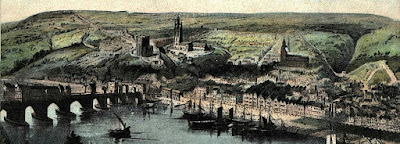
| 17th Century Berwick |
Sitting in the House of Lords were the Bishop of Durham and the Earl of Northumberland. [9]
The Bishop of Durham was Richard Neile who had been appointed in 1617. [10] Neile had appointed William Laud, Charles I future Archbishop of Canterbury, as his chaplain when he was Bishop of Rochester. Neile would go on to use his political connections to become part of the Kings Privy Council.
 |
| Richard Neile Bishop of Durham |
NEXT: Charles I in conflict with Parliament
------------
] Richard Lomas, An Encyclopaedia of North East England, Edinburgh: West Newington House; 2009 page 333-335 Northumbria
[2] ibid page 348 Palatinate of Durham
[3] ibid page 348 Palatinate of Durham
[4] Simon Healey http://www.historyofparliamentonline.org/volume/1604-1629/constituencies/newcastle-upon-tyne
[5] Paul Hunneyball http://www.historyofparliamentonline.org/volume/1604-1629/constituencies/northumberland
[6] Simon Healey http://www.historyofparliamentonline.org/volume/1604-1629/constituencies/newcastle-upon-tyne
[7] Paul Hunneyball http://www.historyofparliamentonline.org/volume/1604-1629/constituencies/morpeth
[8] Paul Hunneyball http://www.historyofparliamentonline.org/volume/1604-1629/constituencies/berwick-upon-tweed
[9] 'House of Lords Journal Volume 3: 9 August 1625', in Journal of the House of Lords: Volume 3, 1620-1628 (London, 1767-1830), pp. 477-485.
[10] List of the bishops of Durham | CCEd (theclergydatabase.org.uk)